

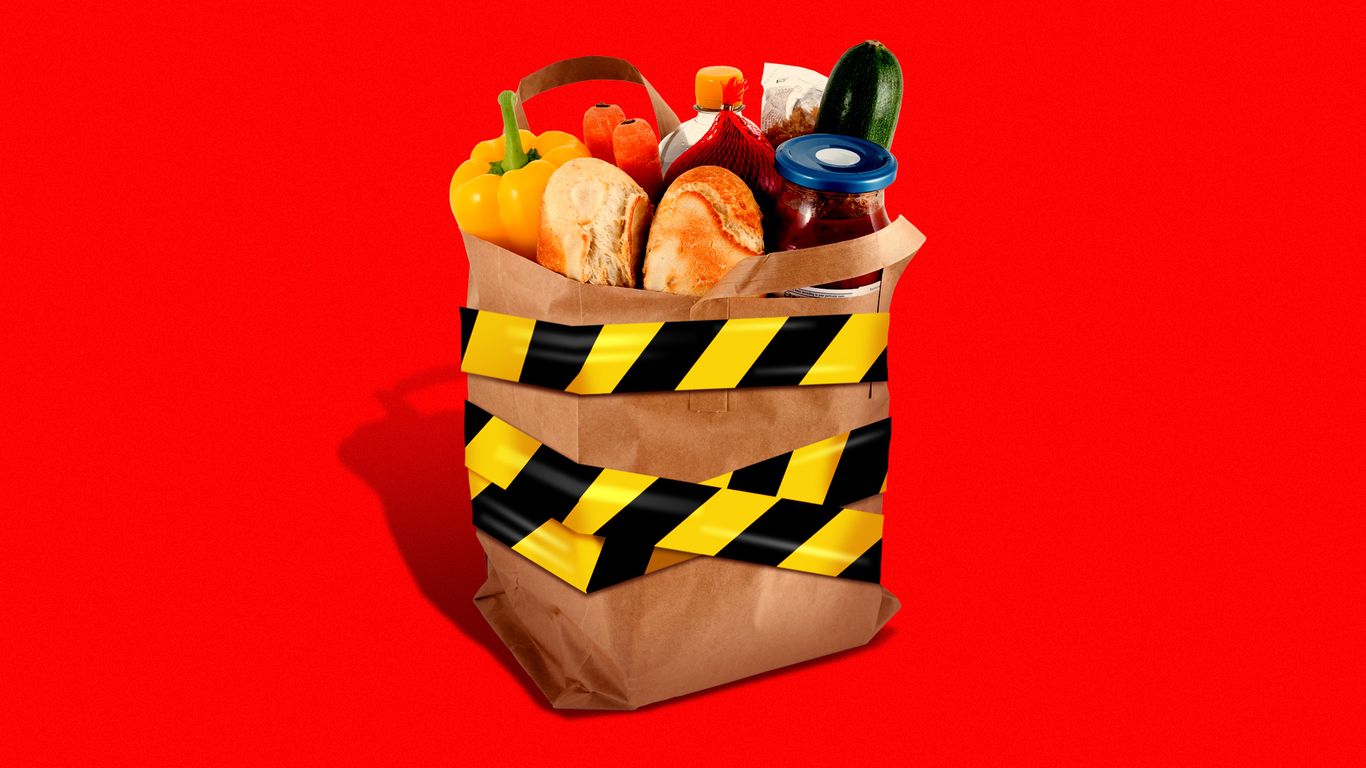
A cart that cost $300 in 2019 runs about $400 now. That's not a hypothetical — it's the number Kurt Grichel, who runs Bain's Americas retail practice, uses to explain why the latest US grocery unit sales number looks so bad. In June, the number of items Americans bought at the supermarket fell 1.8% from a year earlier, according to a new Bain & Company analysis of NielsenIQ data shared exclusively with CNBC. A year ago, that same figure was still positive, up 0.1%. That's a swing of nearly two full points in twelve months, and it's part of a run of similarly weak months stretching back to February — inflation used to hide this kind of pullback, and now it can't.
Nota principal · CNBC, July 16, 2026Shoppers are pulling back hard enough that unit declines are now outweighing price gains — the exclusive data set that kicked off this story, with on-the-record comments from Bain's Kurt Grichel and PepsiCo CEO Ramon Laguarta.
The math that stopped working
For most of the last few years, grocery chains and the companies that stock their shelves got away with a simple trick: raise prices a little, and even if people buy slightly less, total sales still go up. That trick is over. Bain's data shows grocery prices are still climbing 2% to 3% a year, roughly in step with food-at-home inflation, and cumulatively they're now about 33% higher than in 2019. But the volume decline has gotten steep enough — down close to 2% year over year in most months since February, and consistent across every US region Bain tracked — that the price increases can no longer cover for it. Sales, not just satisfaction, are taking the hit.
Bain isn't pointing to one single cause — its analysts describe pressure that built up over more than a year and then accelerated sharply in 2026. Gas prices climbed over 20% in March, a direct hit to weekly budgets. A cut to SNAP benefits took effect in late 2025, and tighter eligibility rules followed in early 2026, both landing hardest on lower-income households. More grocery shopping has also shifted online, where shoppers typically load up smaller baskets, and Bain flags rising GLP-1 adoption as another factor — the firm notes an estimated 30% to 40% of users say they're actively cutting back on groceries.
There's a cushion keeping things from looking worse than they are. Bain's own Consumer Health Index — a composite read on household sentiment — has only just clawed back to neutral after sliding for most of the past year, and a tax-refund season worth roughly $50 billion more than last year's, plus leftover pandemic-era savings, are propping up nominal spending for now. But intent-to-spend among lower- and middle-income households still sits at or below its long-term average, which is the group Bain expects to keep pulling back first.
Big food brands are feeling it in real numbers
This isn't an abstract trend for the companies that make what's in the cart. PepsiCo reported its second quarter on July 9, and North American food revenue was down 2% with volume essentially flat. "I think the consumer is worse than what we had anticipated," CEO Ramon Laguarta told analysts on the earnings call, pointing mainly to gas prices as the driver. On the same call, an analyst asked Laguarta to reconcile that with the strength PepsiCo had described in its fall test markets — a question that underscores how much the picture shifted between the pilot and the national numbers.
Conagra, which makes Slim Jim and Duncan Hines, posted its own second quarter in mid-July: organic sales down 3.0% year over year and volume down 1.6%, alongside a $968 million non-cash impairment charge tied to its sagging share price. General Mills and PepsiCo were already cutting prices back in February — General Mills on close to two-thirds of its North American grocery products, PepsiCo by as much as 15% on some snack brands — and it still wasn't enough to turn volumes positive by summer. Axios reports that Kraft Heinz and Mondelēz have logged similarly flat or declining North American volume so far this year. This isn't a PepsiCo problem, it's an industry one.
Retailers are responding the only way that actually moves units: by competing on price. Walmart announced cuts on a run of summer staples, including ground beef, ice cream, Coca-Cola and PepsiCo products. Kroger has been reported to be planning some of its biggest price cuts in years, aimed squarely at Walmart and Costco. Joe Feldman, an analyst at Telsey Advisory Group, put it plainly: grocers are pushing suppliers to bring prices down where they can, because "the entire industry is trying to get back to unit growth."
Why I don't think this resolves quickly
What strikes me about this data isn't the 1.8% by itself — one bad month wouldn't be a story. It's that unit sales have been negative in most months since February, consistently across the country, and the deterioration keeps compounding instead of leveling off. Grichel's own framing — that winning back growth takes a genuine value proposition, not just a round of discounting — is a longer, harder fix than a one-time price cut, and it suggests this isn't a quarter-long dip that reverses once gas prices ease. Add in a tax-refund bump and pandemic savings that are already thinning out, and the cushion keeping this from looking worse won't last much longer either.
It's a household budget that's been stretched from multiple directions at once — gas, SNAP, GLP-1s, five straight months of falling volume — and grocery is where people finally started saying no. That's worth remembering the next time a company brushes off softer demand as temporary.
Track your own numbers, not just the headlines
Whatever's happening to grocery prices, knowing exactly what you're bringing in matters more when costs keep climbing. Run your income and expenses through Calcugui's free calculator.
Try the Calculator →